Local Conditions That Matter for Refrigerator Repair in San Francisco
San Francisco's laundry is often in garages or basements of Victorian and Edwardian buildings, and many apartments share coin-op machines.
A large share of homes are Victorian, Edwardian and 1920s–1940s row houses and flats, where laundry often sits in a garage or basement-level room with long, twisting dryer vent runs. Daly City and the northern Peninsula sit right in the fog belt, and many homes from the 1940s and '50s were built as tight rows of single-family houses with ground-floor garages.
Kitchens in older flats are often compact, which is why slim 18-inch dishwashers, apartment-size ranges and over-the-range microwaves are common.
What that means for your refrigerator: Coastal moisture can corrode connectors slowly, causing intermittent faults that are hard to pin down. Water here is relatively soft, so scale is less likely to be the cause; wear, clogs and electrical faults are more common culprits.
PG&E serves most of San Francisco. Tripped breakers and GFCI outlets are easy to overlook, so check both before deciding your refrigerator has a failed part.
If your refrigerator sits against an exterior wall in an unheated garage, check that the garage doesn't drop below the temperature the manual allows.
Common Refrigerator Repairs in San Francisco Homes
Each section below covers one specific repair, the parts involved and the signs that point to it.
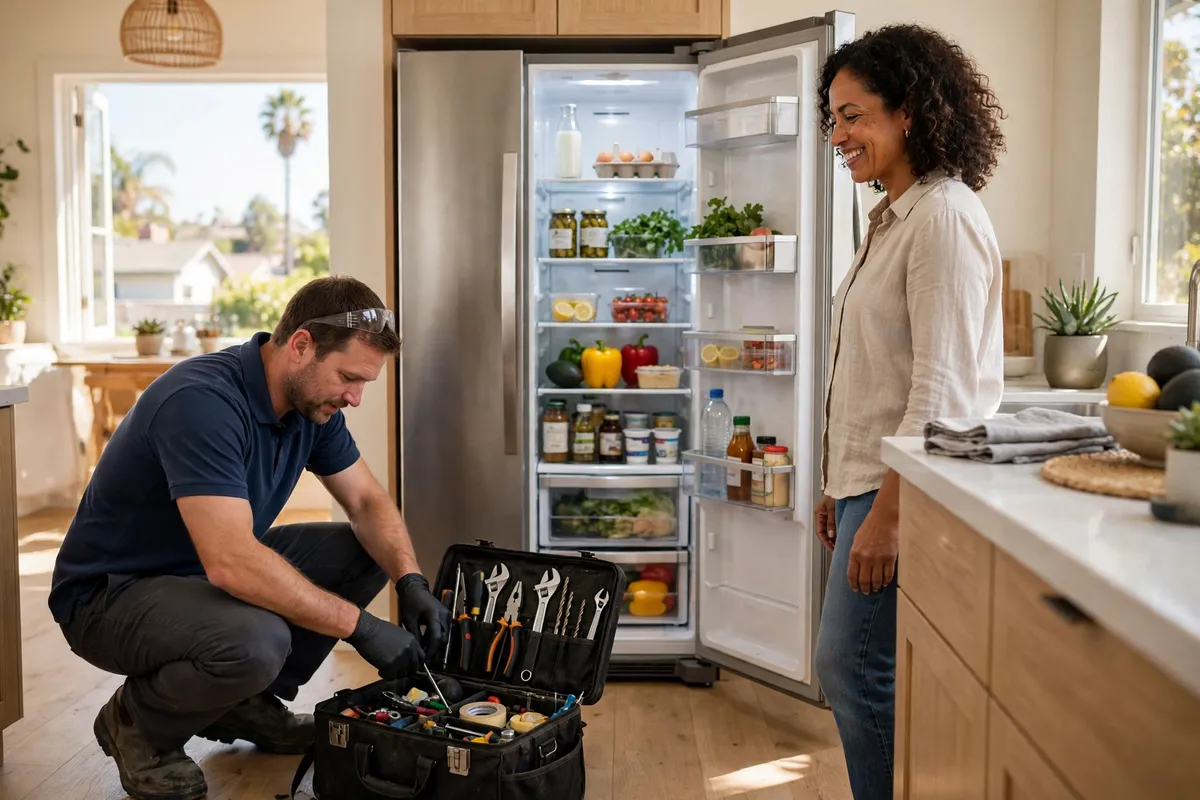
Refrigerator Not Cooling? Repair in San Francisco
A stuck damper door keeps freezer air from flowing into the refrigerator section. Marginal parts tend to fail when kitchen temperatures climb. Overpacking blocks the airflow paths that the cooling system depends on. Most warm fridges are fixed without touching the refrigerant at all. Cooling that fades as the day warms up usually means the condenser side can't keep up.
If you're in San Francisco, start your troubleshooting here.
Quick things to rule out: Unplug the fridge for five minutes and plug it back in to reset the control board. Put an appliance thermometer in a glass of water on the middle shelf; it gives a truer reading than the air.
- Compressor runs constantly
- Butter feels soft on the door shelf
- Drinks never feel properly cold
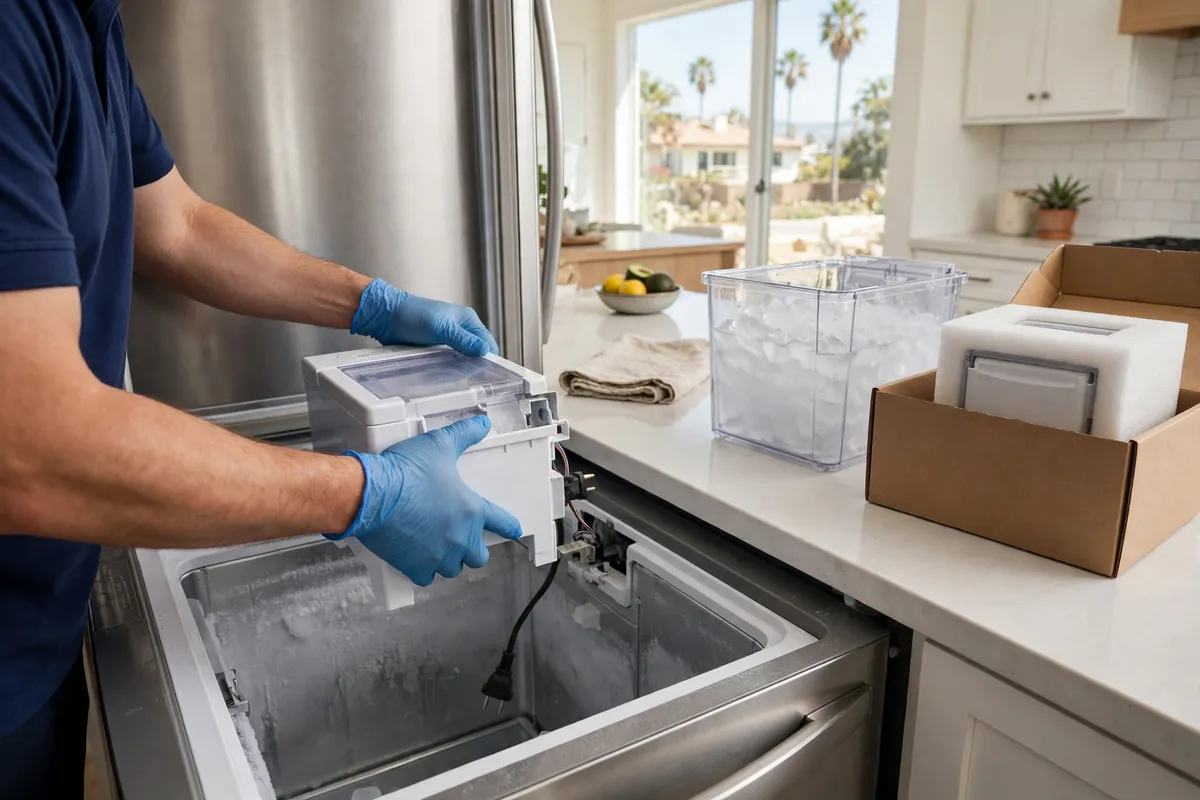
Refrigerator Ice Maker Repair in San Francisco
If the bin-full sensor is blocked by ice, production pauses. Clumped ice points to temperature swings in the freezer. Ice makers in the door rely on a dedicated duct that can frost over. Low water pressure is like a weak garden hose: the mold never fills, so cubes come out small or hollow. If you hear the ice maker try to fill but get no water, it's often the valve or a frozen fill tube.
Pros serving San Francisco see this one regularly.
Easy checks for San Francisco homeowners: Look for ice blocking the fill tube at the back of the ice maker. Check that the shutoff valve behind the fridge is fully open and the line isn't kinked.
- Small, hollow or misshapen cubes
- Ice tastes stale
- Water dispenser works but no ice
Refrigerator Door Gasket Replacement in San Francisco
After cleaning, a gasket may fold over and leave a hidden gap. Every gap in the gasket adds run time and energy use. Gasket folds trap moisture, so mildew appears in humid homes. Mild heat sometimes relaxes a creased gasket enough to seal again. Replacing a gasket is usually a modest repair compared with the cost of a struggling fridge.
Worth checking in a few minutes: Clean the gasket with warm soapy water; sticky residue can keep it from seating. Wipe the gasket with warm water and mild soap, then dry it fully.
- Condensation forms around the door edge
- Condensation on the gasket
- Frost builds up near the door
Noisy Refrigerator Fan Repair in San Francisco
Ice on the fan shroud can make a loud scraping or chirping sound. On newer models, the main board times the defrost cycle. If the evaporator fan stops, the freezer coil keeps getting cold but the fridge section warms up. The evaporator fan usually stops when the freezer door opens, so test it with the door switch pressed. Manual defrosting is a temporary fix; the frost returns if the defrost part isn't replaced.
Easy checks for San Francisco homeowners: Open the freezer and listen; the fan should run when the door switch is pressed in. Shine a light through the freezer vents to look for frost on the coil.
- Frost returns after defrosting
- Fridge cools again after a manual defrost
- Ice buildup around the fan
Leaking Refrigerator Repair in San Francisco
A worn compression fitting on the water line can drip slowly for weeks. During each defrost cycle, melted frost runs down a small tube into a pan under the fridge, where it evaporates; a clog sends that water inside instead. Puddles at the front can come from the water line to the dispenser or ice maker. Moving a fridge can kink or crack an old plastic supply line. If the puddle shows up right after getting water, suspect the dispenser plumbing.
Quick things to rule out: Check behind the fridge for drips at the water line connection. Flush the freezer's drain opening gently with warm water.
- Water dripping from the dispenser
- A damp floor appears after the ice maker runs
- Ice in the drain area
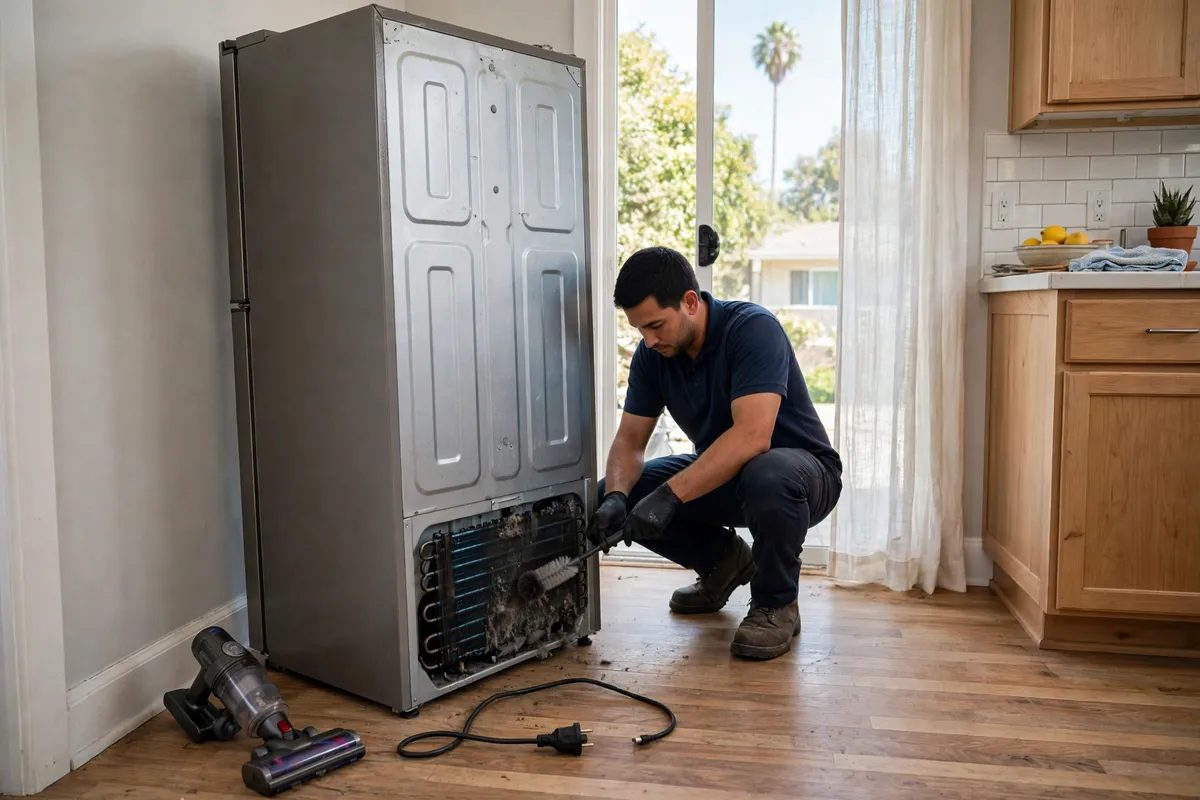
Condenser Coil Cleaning and Fan Repair in San Francisco
Grease from nearby cooking helps lint stick to the coils. Pet hair is one of the fastest ways to clog a condenser. Less dust on the condenser means the fridge uses less power. A compressor that keeps tripping its overload is often a symptom of dirty coils. Fan motors often weaken over months, so cooling fades rather than stopping overnight.
Try this first: Leave a small gap behind the fridge so warm air has somewhere to go. Listen for a rattle or scraping from the fan area at the bottom back.
- No fan noise from the back
- The kick plate blows hot air
- Compressor hot to the touch
Other refrigerator problems
Other issues local technicians see in San Francisco, though less often: garage refrigerator problems; compressor and start relay diagnosis.
Before You Call: What to Check
- Note which compartment is warm and since when.
- Note whether the freezer is also warm.
- Put an appliance thermometer on the middle shelf overnight.
- Find the model number inside the fridge.
How the Repair Usually Goes
- Describe the problem. Describe the symptom, any error code and when it first appeared.
- Diagnosis. A technician tests the likely parts to find the cause.
- Estimate. Get the cost of parts and labor before saying yes to the repair.
- Repair and test. Once the repair is done, the appliance is tested under normal use.
San Francisco Refrigerator Repair FAQ
Can I keep a regular fridge in the garage?
In cold weather, the fridge's thermostat senses the cool garage and stops running, so the freezer warms. A second fridge that's mostly empty cycles more and holds temperature less steadily.
Is it worth repairing a refrigerator in San Francisco?
It depends on the age and the part. Fans, relays, gaskets and defrost parts are usually worth fixing; sealed-system repairs on older fridges may not be. Because the local water is soft, mineral buildup is rarely the main issue, which helps a technician rule things out faster.
How long can food stay in a warm refrigerator?
Perishable food shouldn't be held above 40°F for more than two hours.