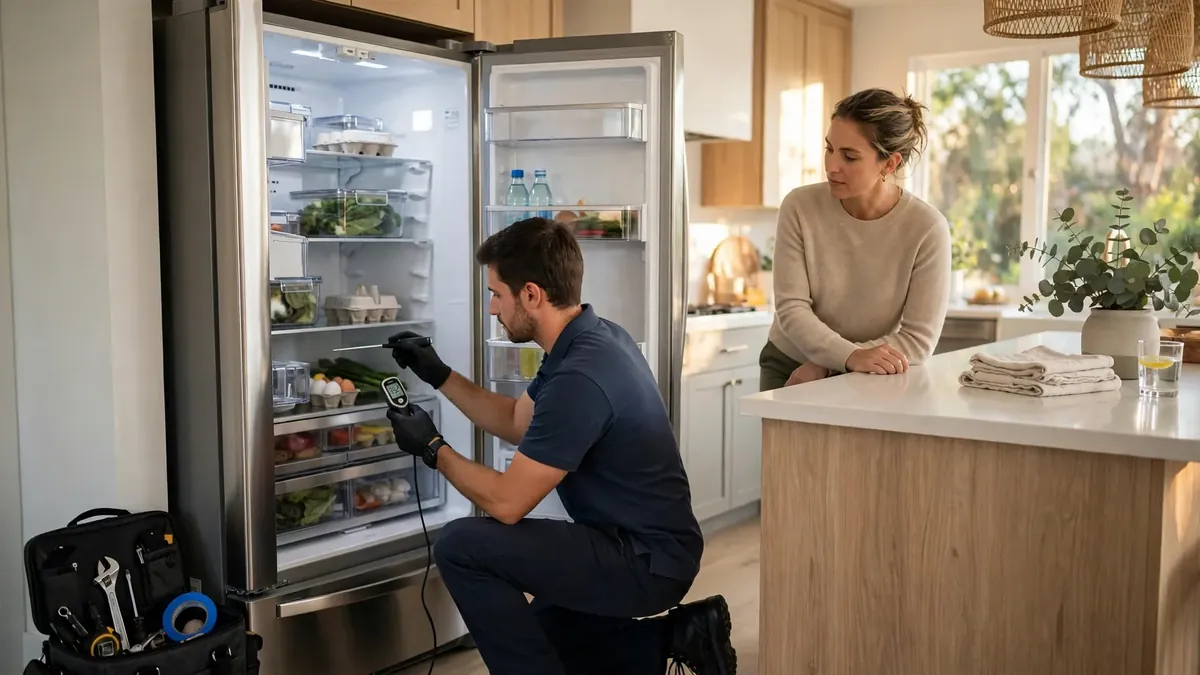
Refrigerator repair services usually start with the simple things: coils, fans and seals. Many warm refrigerators have a failed fan or a defrost problem rather than a dead compressor.
Knowing which compartment is warm, whether the compressor runs, and the model number helps a technician diagnose the problem quickly.
Common Refrigerator Problems and Repairs
Refrigerator not cooling
A refrigerator that runs but stays warm usually has an airflow or heat-rejection problem rather than a dead compressor. The usual suspects are dusty condenser coils under or behind the unit, a condenser fan that has stopped spinning, or an evaporator fan that no longer pushes cold air from the freezer into the fresh-food side. A technician will check the coils, both fans and the start relay before looking at the sealed system, which is the costliest repair.
- Fresh-food section above 40°F
- Freezer cold but fridge warm
- Compressor runs constantly
- Clicking every few minutes from the back
Condenser coil and fan service
The condenser coils are where your refrigerator dumps the heat it pulls out of the food. When they're coated in dust and pet hair, or the small condenser fan beside the compressor stops, heat builds up, the compressor runs longer, and the inside warms. Cleaning the coils and replacing a failed fan motor are among the least expensive refrigerator repairs.
- Very warm air at the bottom of the fridge
- Compressor hot to the touch
- Fridge cools at night but not in the afternoon
- No fan noise from the back
Ice maker repair
Ice makers fail for a handful of reasons: the water inlet valve behind the fridge stops opening, the fill tube freezes, the ice maker module's motor or thermostat fails, or the water filter is clogged. If you hear the ice maker try to fill but get no water, it's often the valve or a frozen fill tube. If nothing happens at all, it may be the module or the arm being switched off.
- No ice for more than a day
- Small, hollow or misshapen cubes
- Ice clumped into one block
- Water dispenser works but no ice
Refrigerator water leak repair
Water under a refrigerator usually comes from one of three places: a clogged defrost drain that overflows inside the fridge, a cracked or loose water supply line to the ice maker and dispenser, or a cracked drain pan underneath. Water on the floor at the front often comes from the drain; water at the back is more often the supply line.
- Puddle in front of the fridge
- Water under the crisper drawers
- Ice sheet on the freezer floor
- Wet floor behind the fridge
Door gasket replacement
The rubber gasket around the door keeps cold air in. When it tears, hardens or pulls away, warm air leaks in, the compressor runs longer, and frost builds up near the door. Try the dollar-bill test: close the door on a bill and see whether it slides out easily. If it does, the gasket or the door alignment needs attention.
- Frost near the door
- Condensation on the gasket
- Door doesn't seal on one side
- Dollar bill slides out easily
Evaporator fan and defrost repair
Behind the freezer's back panel, the evaporator fan moves air over the cold coils and into the fresh-food section. A worn fan motor squeals or chirps, especially when the freezer door is opened. If the defrost heater, thermostat or control fails, the coils ice over, airflow stops and the fridge warms even though the freezer stays cold.
- Squealing that changes when the freezer door opens
- Frost on the freezer's back wall
- Fresh-food section warming slowly
- Ice buildup around the fan
Compressor and start relay diagnosis
When a refrigerator clicks every few minutes and never cools, the start relay or overload on the compressor is often the cause. These are small, inexpensive parts. A truly failed compressor or a refrigerant leak is a sealed-system repair, which requires EPA-certified work and is usually the most expensive refrigerator repair.
- Clicking from the back every few minutes
- Compressor hums but doesn't start
- No cooling after a power outage
- Burning smell near the compressor
Garage refrigerator problems
Many refrigerators are designed to run in rooms between about 55°F and 90°F, and a garage can go well outside that range. In summer heat, the compressor may run nonstop and still not keep the box cold; in cold weather, a fridge may stop running long enough for the freezer to thaw. Some models are rated for garages, and many aren't.
- Garage fridge warm on hot afternoons
- Freezer thaws in cold weather
- Compressor never stops running
- Sweating on the outside of the cabinet
Related Help
If you're adding an outdoor refrigerator to a deck or covered porch, plan for shade and airflow around it; a builder such as Home Fence Installation Near Me can help design a deck or porch that keeps outdoor appliances out of direct sun.
Where to Find Refrigerator repair services in California
Local pages are available in 919 California cities. Browse refrigerator repair by California city to read about local conditions where you live.