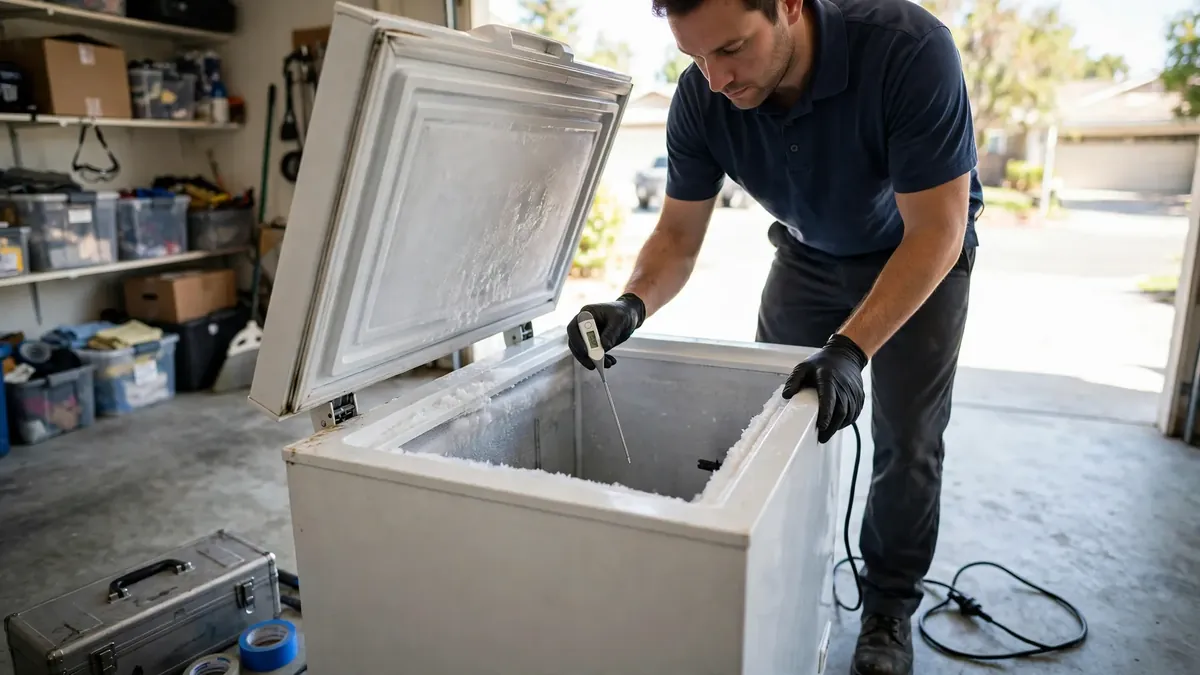
Freezer repair services cover upright, chest and refrigerator freezer compartments. Common problems include defrost failures, thermostats, seals and compressors.
Check the temperature, note any frost, and have the model number ready when you call.
Common Freezer Problems and Repairs
Freezer not freezing
A freezer should hold about 0°F. When food softens or ice cream turns soupy, the usual causes are a failed evaporator fan, a defrost system that has let the coils ice over, a faulty thermostat or temperature sensor, or dusty condenser coils. On older chest freezers, a failing start relay or compressor is more likely.
- Food softening
- Freezer above 10°F
- Compressor running constantly
- No fan noise
Frost and ice buildup
Heavy frost usually comes from warm, humid air getting in through a worn door seal, a door left ajar, or a defrost system that has stopped working. In frost-free freezers, the defrost heater melts ice off the coils several times a day; if it fails, ice builds up until airflow stops.
- Thick frost on walls or shelves
- Door won't close fully
- Frost returns within weeks
- Ice on food packages
Defrost heater and thermostat repair
The defrost system includes a heater, a defrost thermostat or sensor, and a timer or control board. When any of them fails, ice builds up on the evaporator coils. A technician tests each part with a meter to find the failure.
- Freezer works after manual defrost, then fails again
- Ice on the back panel
- Fan blocked by ice
- Water dripping inside
Thermostat and control repair
A thermostat or temperature sensor tells the compressor when to run. When it fails, the freezer may run constantly and freeze everything solid, or not run enough and let food thaw. Upright and chest freezers often use a mechanical thermostat; newer models use electronic sensors and boards.
- Dial has no effect
- Freezer runs nonstop
- Temperature swings
- Food frozen solid or thawing
Door seal replacement
Close the door or lid on a strip of paper at several points around the gasket; if it slides out easily, the seal isn't doing its job. Torn, flattened or hardened gaskets let warm, moist air in, which turns into frost and longer run times. Chest freezers with sagging lids may also need new hinges.
- Frost near the lid or door
- Gasket torn or hard
- Lid doesn't stay closed
- Condensation outside
Garage and outbuilding freezers
Chest and upright freezers in garages and sheds work much harder in summer heat and can stop running in winter cold if they aren't rated for garages. Dust and lint in the garage also clog condenser coils quickly.
- Freezer struggles only in summer
- Thaws in cold weather
- Compressor very hot
- Dusty coils
Freezer problems after a power outage
When power returns after an outage or shutoff, surges and low voltage can damage start relays and control boards. If your freezer doesn't restart, or runs but won't get cold, have it checked.
- Freezer silent after power returns
- Clicking but no cooling
- Display blank
- Breaker tripped
Where to Find Freezer repair services in California
Local pages are available in 347 California cities. Browse freezer repair by California city to read about local conditions where you live.