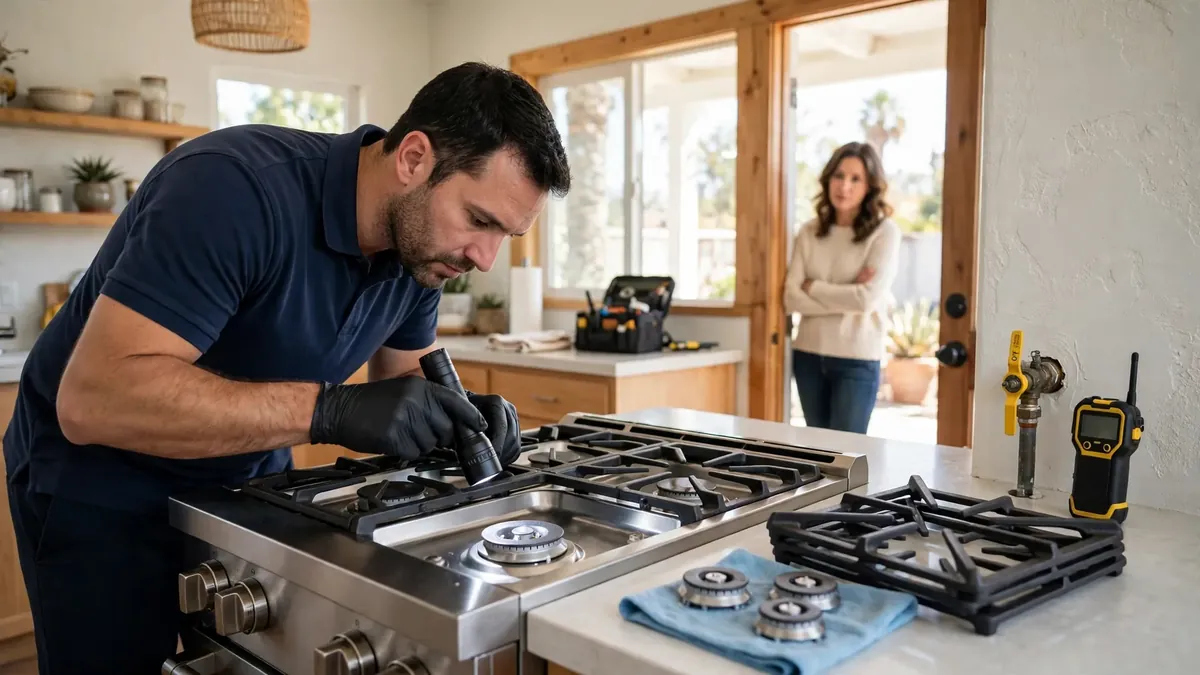
Stove repair services cover burners, igniters, switches, elements and controls on ranges and cooktops.
If you smell gas, leave the home and call your gas utility or 911 from outside before anything else.
Common Stove Problems and Repairs
Gas burner igniter repair
Gas burners light from a small ceramic igniter that sparks when you turn the knob. Spills, moisture after cleaning, or a cap that isn't seated flat can keep it from lighting or make it click nonstop. If cleaning and drying don't help, the igniter, its wire or the spark module may need replacing.
- Burner clicks but won't light
- Constant clicking
- Uneven flame
- Yellow flame
Gas leak and flame problems
If you smell gas, don't use the stove, don't flip switches, leave the home and call your gas utility or 911 from outside. Yellow flames, soot or a gas smell all need prompt attention.
- Gas smell
- Yellow or orange flame
- Soot on pans
- Hissing
Electric coil element and receptacle repair
On coil-top ranges, each element plugs into a receptacle under the drip pan. When a burner works only intermittently or not at all, swapping it with a same-size coil from another burner shows whether the element or the receptacle and switch are at fault. Burned or loose receptacles are common and inexpensive.
- Coil doesn't heat
- Burner heats only on high
- Sparking at receptacle
- Burned receptacle
Glass and induction cooktop repair
Radiant glass cooktops heat with coils under the glass, controlled by switches or a board; induction cooktops use magnetic coils and need compatible pans. A burner that won't heat, stays on high or shows an error code can usually be traced to an element, limiter, switch or board.
- Burner doesn't heat
- Cracked glass
- Error codes
- Burner stays on
Burner switch and control knob repair
Each surface burner on an electric range is controlled by an infinite switch that cycles power on and off to hold a heat level. When the switch's contacts wear out, the burner may stay on high, never get hot, or not turn off. Replacing the switch is usually straightforward with the right part number.
- Burner stuck on high
- Knob loose
- No heat control
- Burner won't turn off
Propane and natural gas conversions
Natural gas and propane burn at different pressures, so ranges need different orifices and regulator settings for each. If a range was moved from a home on natural gas to one on propane, or the reverse, without a conversion, the flames can be too large or too weak. A qualified technician should handle conversions.
- Yellow flame
- Soot
- Flame too large
- Weak flame
Where to Find Stove repair services in California
Local pages are available in 287 California cities. Browse stove repair by California city to read about local conditions where you live.