Local Conditions That Matter for Refrigerator Repair in Rescue
PG&E has used Public Safety Power Shutoffs in the foothills during fire-weather wind events. Higher-elevation communities get winter snow, and propane ranges, dryers and water heaters are common.
Apple Hill farms around Camino draw heavy fall traffic, which can affect scheduling on weekends.
What that means for your refrigerator: In hot spells, a refrigerator in a warm room or garage has less margin before it falls behind. Power shutoffs and outages here put appliances through hard shutdowns and restarts, and surges when power returns can damage relays and electronic controls.
Rescue homes typically buy power from PG&E. A brief flicker can reset a refrigerator's clock or controls; if it won't come back to normal, a board or relay may have taken the hit.
Keep a cooler and ice packs ready for refrigerator food during power shutoffs.
Common Refrigerator Repairs in Rescue Homes
Each section below covers one specific repair, the parts involved and the signs that point to it.
Warm Refrigerator Repair in Rescue
A stuck damper door keeps freezer air from flowing into the refrigerator section. Marginal parts tend to fail when kitchen temperatures climb. Most warm fridges are fixed without touching the refrigerant at all. Too much food against the vents chokes off circulation inside the box. If both sections are warming, the cause is more often at the condenser, the compressor or its start relay.
In homes in El Dorado County, this comes up often.
Worth checking in a few minutes: Hold a hand near the vent inside the fridge to see whether cold air is moving. Note any recent events such as an outage, a move or a cleaning that might have bumped a setting.
- Milk spoils before its date
- Butter feels soft on the door shelf
- Freezer cold but fridge warm
Refrigerator Compressor and Start Relay Repair in Rescue
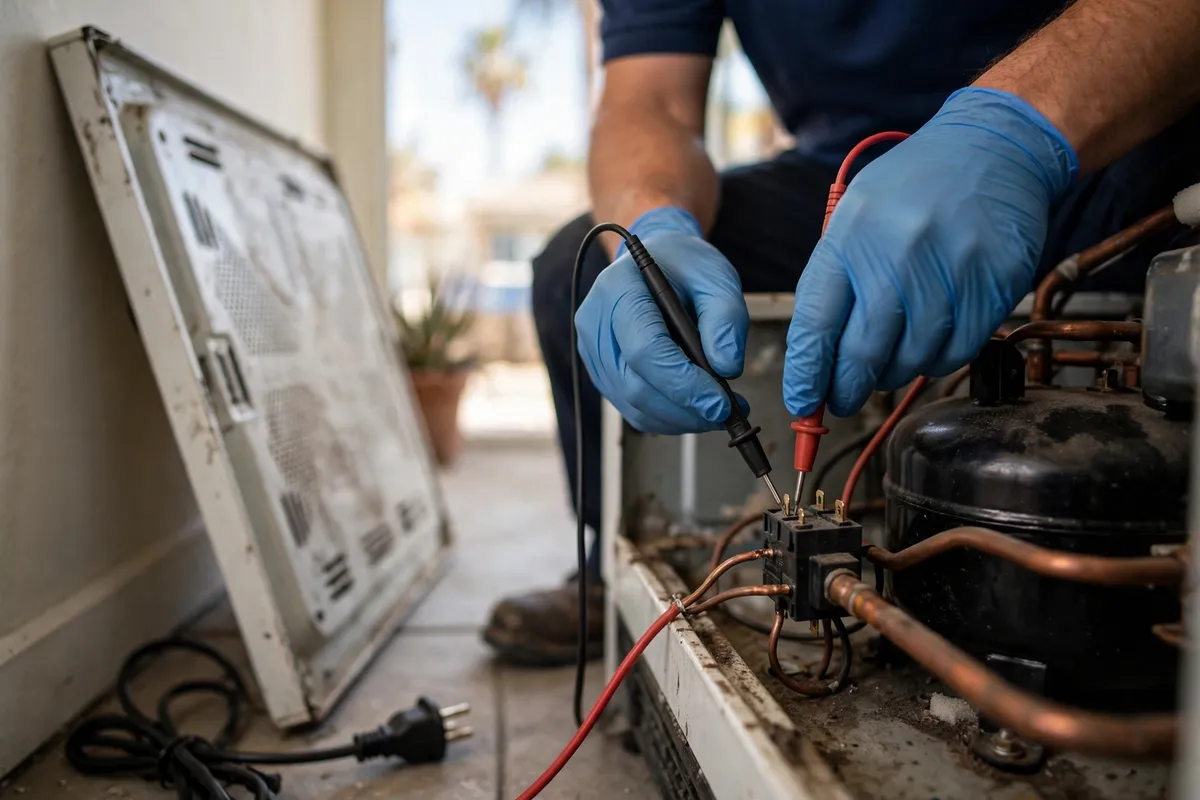
Power outages and surges can damage start relays and electronic control boards. Linear and inverter compressors in newer fridges use electronic controls that are diagnosed differently. Long, hot run times usually trace back to heat rejection problems. Extension cords and overloaded circuits can starve the compressor at startup. A failed overload protector can mimic a dead compressor.
In Rescue, this ranks among the most frequent refrigerator problems.
Easy checks for Rescue homeowners: Feel whether the compressor area is unusually hot. Time how long the fridge clicks off before trying to restart.
- Breaker trips when the fridge starts
- Lights dim when the fridge starts
- The fridge restarts and stops repeatedly
Condenser Coil Cleaning and Fan Repair in Rescue
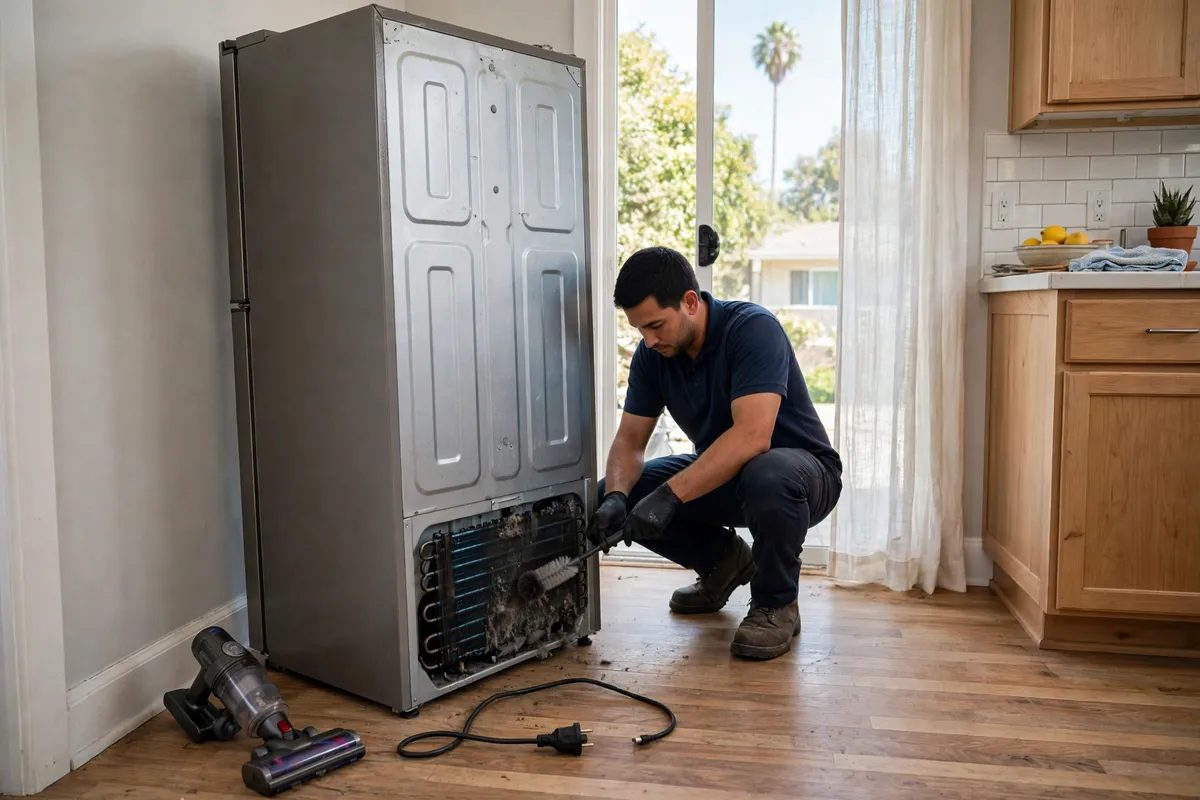
In kitchens, cooking grease mixes with dust and makes coils harder to clean. Homes with dogs or cats tend to need coil cleaning twice as often. On models with coils underneath, the fan that pulls air across them can stall on built-up lint. Clean coils mean shorter run times and lower energy use. A hot exterior on the sides of some fridges is normal, because the coils run through the cabinet walls.
Easy checks for Rescue homeowners: Unplug the fridge, remove the kick plate and vacuum the coils with a brush attachment. Listen for a rattle or scraping from the fan area at the bottom back.
- The kick plate blows hot air
- Fridge cools at night but not in the afternoon
- Noise from the bottom back of the fridge
Noisy Refrigerator Fan Repair in Rescue
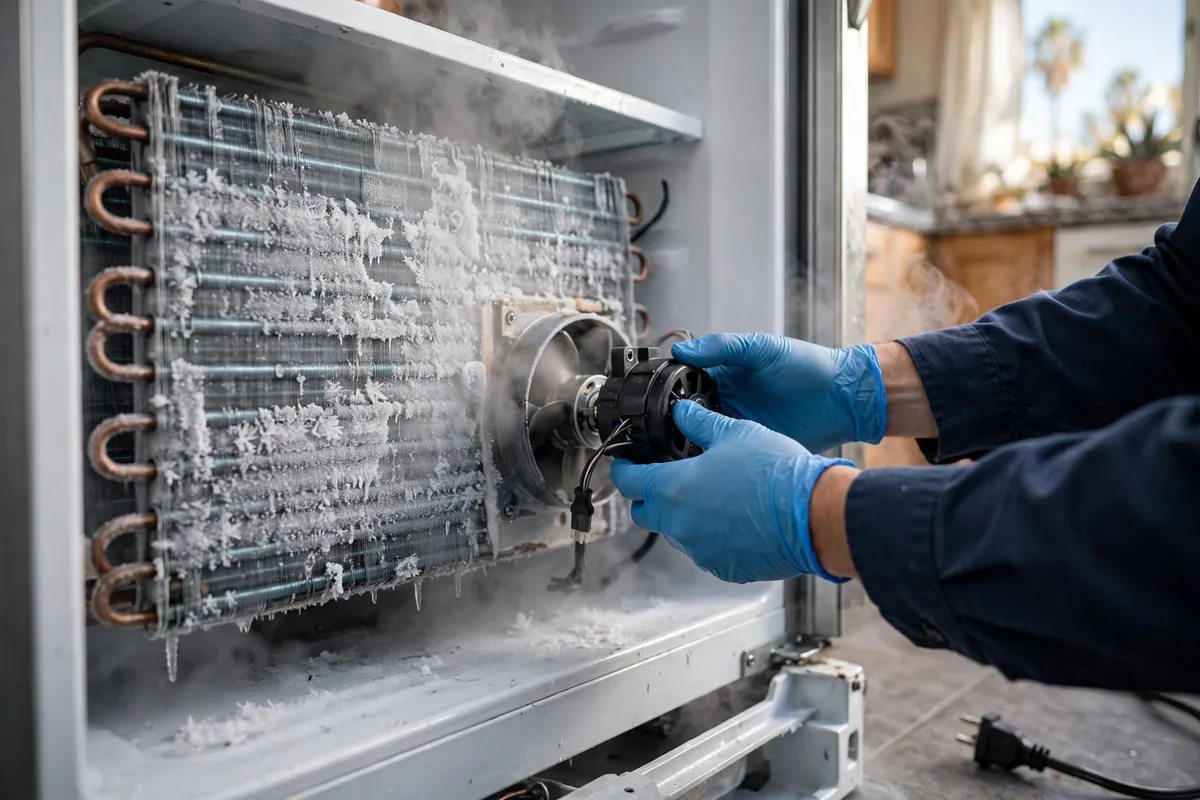
Behind the freezer's back panel, the evaporator fan moves air over the cold coils and into the fresh-food section. A manual defrost buys time, not a repair. A clicking or chirping noise from the freezer often comes from a fan blade hitting ice. The evaporator fan is the fridge's circulation system; without it, cold air stays trapped in the freezer. When defrost parts fail, the decline is slow: cooling fades over days.
Easy checks for Rescue homeowners: Track whether cooling fades again after melting the frost. Hold the door switch in with your finger to check whether the fan runs.
- Fresh-food section warming slowly
- Ice buildup around the fan
- Squealing that changes when the freezer door opens
Refrigerator Ice Maker Repair in Rescue
A sluggish inlet valve is a common reason for undersized cubes. Ice that clumps together usually means it partially melted and refroze. Stale-tasting cubes are usually a filter or storage issue, not a broken part. Many ice makers stop producing when the bin's shutoff arm is raised or a sensor thinks the bin is full. If nothing happens at all, it may be the module or the arm being switched off.
What you can check yourself: Empty the ice bin and break up any clumps blocking the auger. Look for ice blocking the fill tube at the back of the ice maker.
- Small, hollow or misshapen cubes
- The dispenser sputters
- The ice maker makes a grinding sound
Refrigerator Water Leak Repair in Rescue
A slow leak can damage flooring and subfloors before you notice it, especially under laminate and wood. Small leaks soak into wood and laminate floors quietly. Turn off the water supply to the fridge if you can find the valve, and wipe up the water so you can see whether it comes back at the front or the back. Plastic water lines can become brittle and split, especially after the fridge is moved. A cracked fill tube or loose fitting on the ice maker can drip behind the fridge.
Before booking a visit, check this: Flush the freezer's drain opening gently with warm water. Shut the valve feeding the ice maker until the leak is fixed.
- Water dripping from the dispenser
- Wet spots behind the fridge
- Water under the crisper drawers
Other refrigerator problems
These come up less often around Rescue, and local pros handle them too: garage refrigerator problems; door gasket replacement.
What to Note Before Calling
- Note which compartment is warm and since when.
- Check the temperature setting.
- Find the model number inside the fridge.
- Note whether the freezer is also warm.
What to Expect From the Visit
- Describe the problem. Share what the appliance is doing, when it started and the model number.
- Diagnosis. A technician tests the likely parts to find the cause.
- Estimate. Get the cost of parts and labor before saying yes to the repair.
- Repair and test. After the part is swapped, the technician runs the appliance to confirm the fix.
Rescue Refrigerator Repair FAQ
How long can food stay in a warm refrigerator?
Perishable food shouldn't be held above 40°F for more than two hours.
Can I keep a regular fridge in the garage?
Most household fridges are designed for indoor temperatures, roughly 55°F to 90°F. A tripped GFCI outlet in the garage can silently cut power.
Is it worth repairing a refrigerator in Rescue?
It depends on the age and the part. Fans, relays, gaskets and defrost parts are usually worth fixing; sealed-system repairs on older fridges may not be. After a power shutoff, a refrigerator that clicks but won't cool may have a damaged start relay, and food that sat above 40°F for more than two hours should be thrown out.