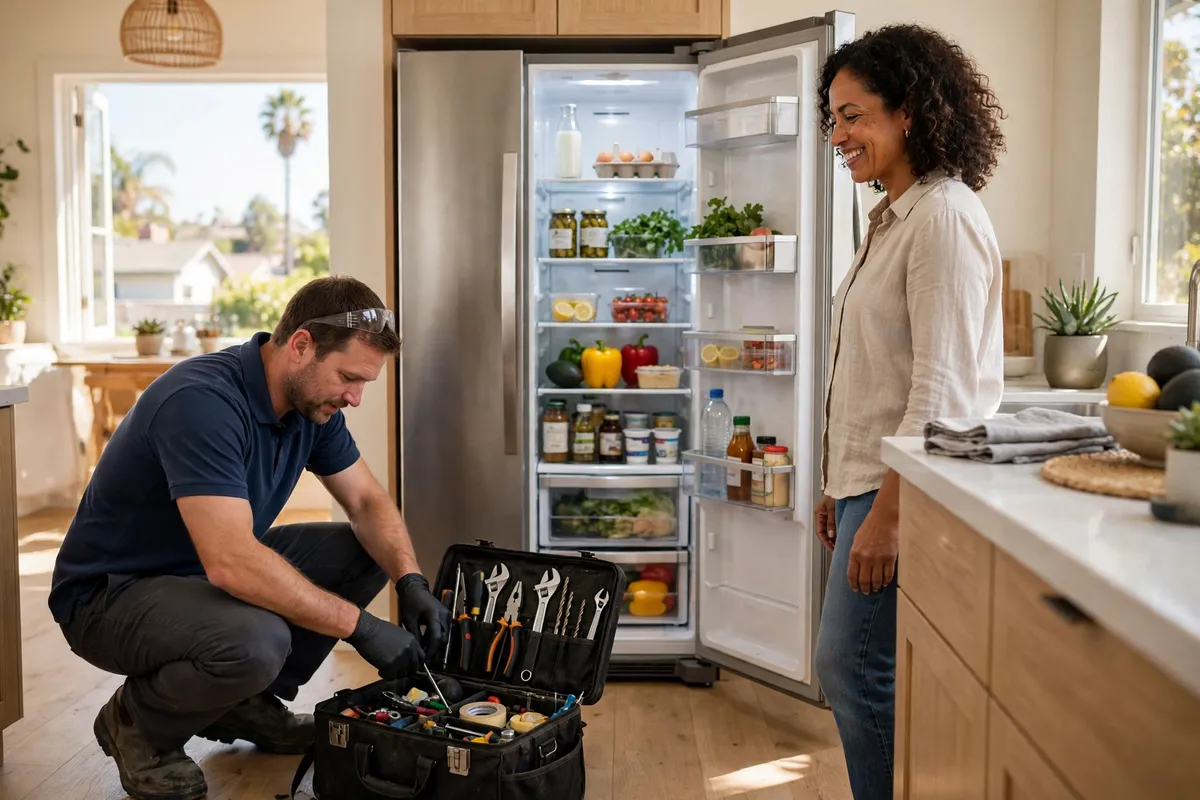
What Affects Refrigerator Repair in Cool
Apple Hill farms around Camino draw heavy fall traffic, which can affect scheduling on weekends. Higher-elevation communities get winter snow, and propane ranges, dryers and water heaters are common.
PG&E has used Public Safety Power Shutoffs in the foothills during fire-weather wind events.
What that means for your refrigerator: In hot spells, a refrigerator in a warm room or garage has less margin before it falls behind. After a shutoff, give the refrigerator a few minutes to restart before assuming something is broken.
Most homes in Cool get electricity from PG&E. A refrigerator that misbehaves right after an outage or a flicker may have a damaged control board or relay, so note the timing.
Keep a cooler and ice packs ready for refrigerator food during power shutoffs.
Common Refrigerator Repairs in Cool Homes
Not every problem needs a technician, so each section starts with what's going on and what you can rule out yourself.
Warm Refrigerator Repair in Cool
When the temperature sensor drifts, the board shuts the cooling off too early. Marginal parts tend to fail when kitchen temperatures climb. Overpacking blocks the airflow paths that the cooling system depends on. Above 40°F, bacteria multiply quickly, so time matters once the fridge warms. Telling a pro which compartment is warm, and since when, speeds up the diagnosis.
Pros serving Cool see this one regularly.
A few safe steps to try: Move items away from the vent at the top of the fresh-food section. Hold a hand near the vent inside the fridge to see whether cold air is moving.
- Compressor runs constantly
- Milk spoils before its date
- Butter feels soft on the door shelf
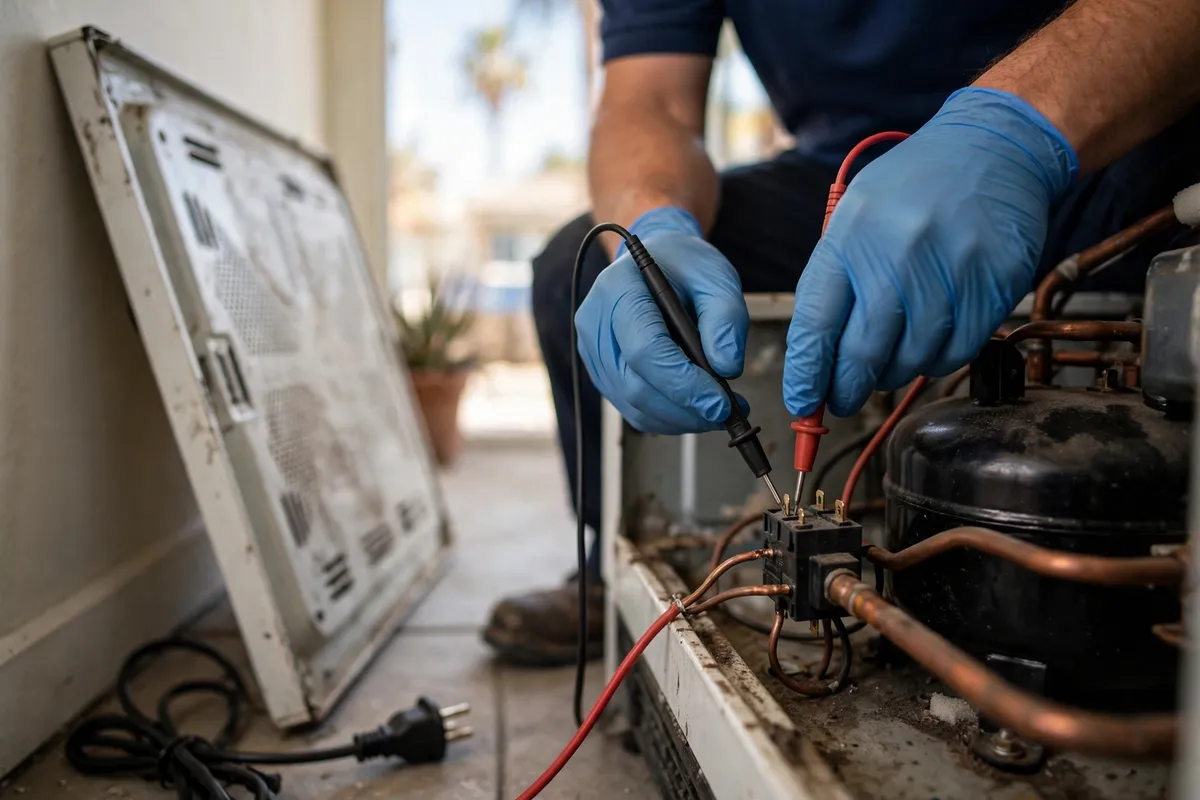
Refrigerator Compressor and Start Relay Repair in Cool
A failed overload protector can mimic a dead compressor. A failed compressor on an older fridge often makes replacement the better value. Voltage problems from a shared circuit or extension cord can make a compressor struggle to start. Long, hot run times usually trace back to heat rejection problems. A truly failed compressor or a refrigerant leak is a sealed-system repair, which requires EPA-certified work and is usually the most expensive refrigerator repair.
If you're in Cool, start your troubleshooting here.
Quick things to rule out: Feel whether the compressor area is unusually hot. Plug the fridge directly into the wall, not an extension cord or power strip.
- A humming that never turns into steady running
- Clicking every few minutes from the back
- The compressor is too hot to touch
Noisy Refrigerator Fan Repair in Cool
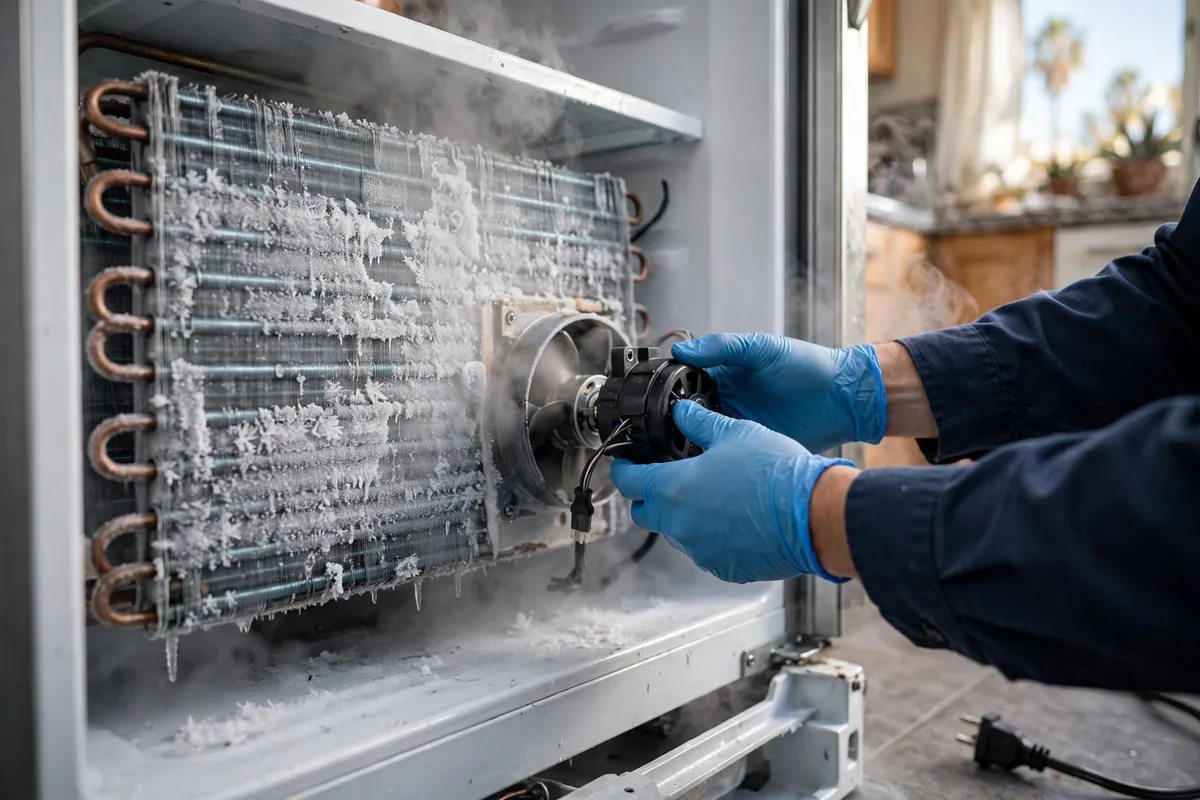
A fan blade striking ice makes a distinctive chirp. On newer models, the main board times the defrost cycle. If the defrost heater, thermostat or control fails, the coils ice over, airflow stops and the fridge warms even though the freezer stays cold. Press the door switch to hear whether the freezer fan actually runs. A defrost thermostat or heater failure lets frost build up gradually over several days.
Safe checks before you call: Track whether cooling fades again after melting the frost. Look for a thick layer of frost on the back panel inside the freezer.
- Fridge cools again after a manual defrost
- Ice buildup around the fan
- Fresh-food section warming slowly
Second Refrigerator in the Garage: Repair in Cool
A garage kit adds a small heater near the thermostat so the fridge runs in winter. Nests and chewed wires show up more often in garage fridges. Sunlight hitting the fridge raises its workload noticeably. Garage-ready models are built to handle a wider temperature range. Garage GFCI outlets trip easily, so check them if the fridge is warm.
A few safe steps to try: Fill empty shelves with water bottles to add thermal mass. Leave space around the fridge for airflow, especially in summer.
- Dust coats the coils quickly
- Compressor never stops running
- Fridge works fine after being moved indoors
Condenser Coil Cleaning and Fan Repair in Cool
Fan motors often weaken over months, so cooling fades rather than stopping overnight. Pet hair is one of the fastest ways to clog a condenser. Some models route condenser tubing through the side walls, so warm sides aren't always a problem. Clean coils won't fix a failed part, but they often turn a fridge that barely keeps up into one that cools normally again. Cleaning the coils and replacing a failed fan motor are among the least expensive refrigerator repairs.
Worth checking in a few minutes: Leave at least an inch of space behind and above the fridge so heat can escape. Unplug the fridge, remove the kick plate and vacuum the coils with a brush attachment.
- Noise from the bottom back of the fridge
- The kick plate blows hot air
- No fan noise from the back
Refrigerator Ice Maker Repair in Cool
A sluggish inlet valve is a common reason for undersized cubes. Ice that clumps together usually means it partially melted and refroze. If you hear the ice maker try to fill but get no water, it's often the valve or a frozen fill tube. A bad-tasting or cloudy batch usually points to an old filter or stale ice. Ice makers in the door rely on a dedicated duct that can frost over.
Easy checks for Cool homeowners: Make sure the freezer is cold enough before blaming the ice maker. Remove the bin and clear stuck ice from the chute.
- The ice bin is empty for days
- Ice cubes are small or hollow
- Ice clumped into one block
Other refrigerator problems
Pros serving Cool also handle these less common problems: refrigerator water leak repair; door gasket replacement.
Quick Checks Before You Call
- Find the model number inside the fridge.
- Check the temperature setting.
- Note whether the freezer is also warm.
- Move perishables to a cooler.
What to Expect From the Visit
- Describe the problem. Mention any noises, smells or error codes, plus the model number.
- Diagnosis. The likely parts are checked one by one until the cause is confirmed.
- Estimate. Ask for the total cost including parts and labor before approving the repair.
- Repair and test. The failed part is replaced and the appliance runs a full test.
Cool Refrigerator Repair FAQ
Why is my refrigerator leaking water?
A dislodged pan under the fridge turns normal defrost water into a puddle. A cracked fill tube or loose fitting on the ice maker can drip behind the fridge.
How long can food stay in a warm refrigerator?
Perishable food shouldn't be held above 40°F for more than two hours.
Is it worth repairing a refrigerator in Cool?
It depends on the age and the part. Fans, relays, gaskets and defrost parts are usually worth fixing; sealed-system repairs on older fridges may not be. Outages and surges are a common reason refrigerators stop cooling here; the start relay and control board are the first things to test.